We'll Have More Shelf Space
Responding to "Gen Z Is Reading Less. What That Means In The Age Of Ready Answers" by Vibhas Ratanjee
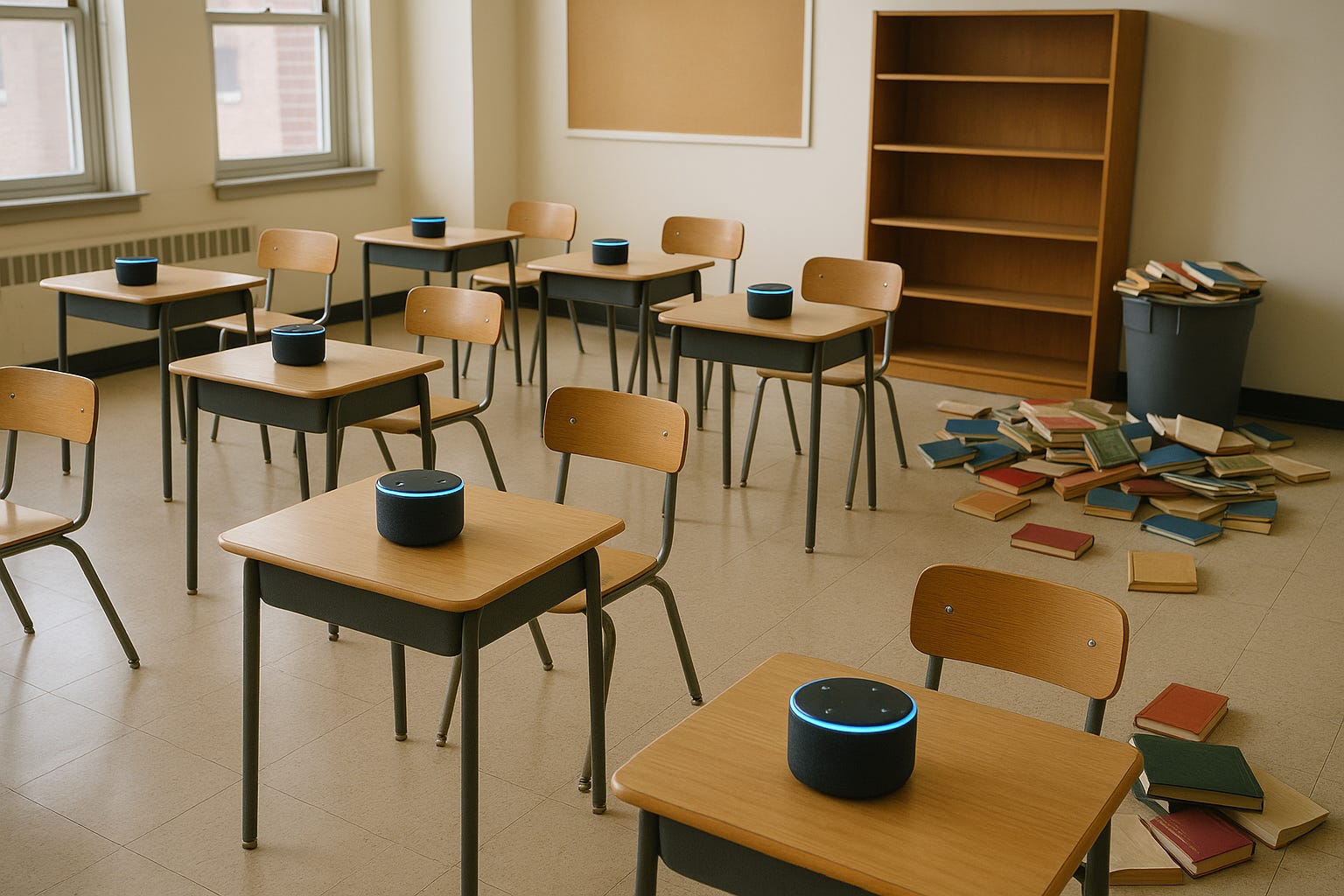
In recent Forbes article, “Gen Z Is Reading Less. What That Means In The Age Of Ready Answers”, Vibhas Ratanjee warns that Gen Z’s retreat from reading is colliding with a world built on instant responses. He argues that when students stop wrestling with language, they lose the patience, imagination, and interpretive strength that books uniquely cultivate. The result, he suggests, is a rising workforce fluent in tools but thin in perspective—quick to execute, slower to reflect, and less practiced in holding complexity. His argument aligns with what I’ve been developing in my book: the real cost isn’t the decline in information consumption. It’s the erosion of the underlying mental architecture that deep reading builds.
Books train the mind to enter full absorption, the state where internal simulations take shape, long-form attention strengthens, and slow reasoning has room to work. Deep reading doesn’t hand over someone else’s knowledge; it lets you reconstruct it. Neuroscience shows that when a reader becomes absorbed, the brain mirrors lived experience. The line between “what I read” and “what I’ve actually worked through” begins to blur.
That difference matters. Information consumed fades quickly. Information integrated becomes part of the person—easier to recall, easier to apply, and far harder to manipulate.
It also matters for creativity. Research across psychology and neuroscience is clear: creativity depends on a deep internal store of knowledge and the mental structures that allow ideas to recombine. Shallow inputs yield shallow combinations. Deep reading gives the mind the material and the mental scaffolding to generate something genuinely new. Without that substrate, imagination thins. People can operate tools, but have little raw material of their own to draw from.
When a society abandons the forms of thought that books train, we lose more than attention spans and literacy metrics. We lose the habits that steady judgment: patience, reflection, and the willingness to follow a line of reasoning to its end. We drift toward fast conclusions and shallow certainty, which may feel efficient for a moment but leave us with nothing to lean on when problems grow complex.
If the trend continues, we’ll certainly free up space—on our shelves and in our heads. But empty space isn’t clarity. It’s simply unused capacity.
For discussions like this—how AI reshapes cognition, what we stand to lose, and how we strengthen the parts of the mind that keep a society stable—come find me at AI for Augmented Intelligence on Substack.